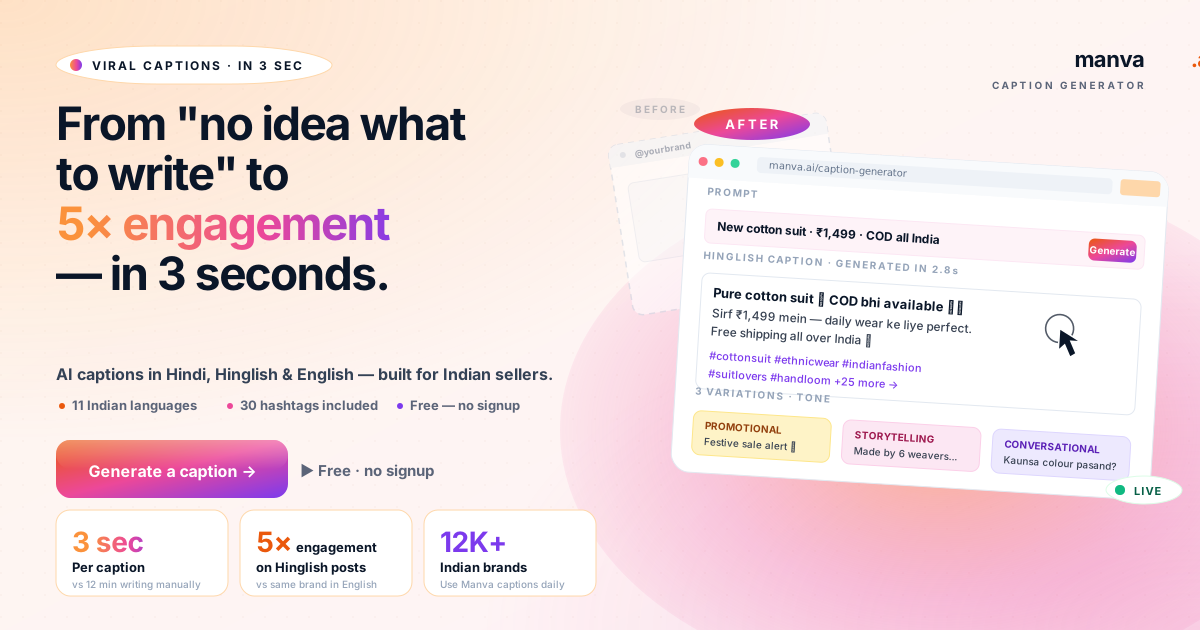
The Indian sellers winning on Instagram in 2026 have one thing in common — they stopped writing captions manually. Not because writing is hard, but because writing 7 captions a week, in Hindi or Hinglish, with the right hooks and hashtags, while running a business, is unsustainable.
This is a practical guide to how AI actually writes Instagram captions for Indian businesses — with the prompts that work, the tones that convert, and the mistakes to avoid. The free Manva caption generator (no signup, 5 free per day) follows exactly the system below.
Why captions matter more in 2026 than ever
Instagram's algorithm now uses caption text as a primary signal for who to show your post to. A vague caption ("New arrivals 🌸") tells the algorithm nothing. A specific caption ("Pure cotton kurti for daily wear, ₹999, COD all India") tells it exactly which Indian users would care.
This is why the same product photo with a better caption can get 5–8× more reach. The bottleneck isn't your photography — it's the words underneath.
The biggest mistake people make with AI is giving it nothing to work with. "Write me an Instagram caption" produces a generic template. The five things to include in your prompt:
- What you sell — "cotton suit" not "ethnic wear"
- Price — "₹1,499" not "affordable"
- Hook or offer — "free shipping", "limited stock", "new colour"
- Audience — "for working women" or "Hyderabad daily delivery"
- Tone — promotional, story, or conversational
"Write Instagram caption for ethnic wear"

→ "Embrace tradition with our latest
collection ✨ Shop now! #fashion
#ethnic #style"
"Cotton suit, ₹1,499, COD all India,
for working women in Hyderabad,
Hinglish promotional"

→ "Daily wear ke liye perfect ✨ Pure
cotton suit, sirf ₹1,499. Hyderabad
mein same-day delivery 🚚"
Manva returns 3 tone variants for every prompt. Each one uses different language patterns and works for different goals:
| Tone | Use it for | Example opener |
|---|---|---|
| Promotional | New launches, sales, COD pushes | "Festive sale alert ✨" |
| Storytelling | Brand-building, founder posts, BTS | "Made by 6 weavers in Pochampally..." |
| Conversational | Engagement-bait posts, Reels, polls | "Kaunsa colour pasand?" |
Language: when to use Hindi vs Hinglish vs English
- Hindi — tier-2/3 cities, regional brands, Hindi-belt audiences. Highest engagement for handicraft, food, festival content.
- Hinglish — the default for most Indian small businesses. Outperforms pure English by 30–60% on engagement and saves.
- English — metro D2C brands, premium price points (₹3,000+), urban professional audiences.
- Tamil / Telugu / Bengali / Marathi etc. — regional brands targeting one state. Manva supports 11 Indian languages.
AI gives you a draft. The 30 seconds you spend personalising it is what makes the difference between AI-quality and human-quality output.
- Change one line to your voice. Add a phrase your customers know you for, swap one emoji for a brand-specific one.
- Move the price to where it converts. If your audience cares about price, put it in line 1. If your brand is premium, push it to line 3.
- Replace generic hashtags. Manva returns 30 hashtags by default — keep the 20 most relevant to your niche, swap the 10 generic ones for city-specific tags (#hyderabadshopping, #mumbaifashion).
Then copy with hashtags in one click and paste into Instagram. Total time per caption: 90 seconds vs the 12 minutes it takes manually.
Stop writing captions one at a time
Manva's Social Media Agent generates a week of captions in 5 minutes — and schedules them across Instagram, Facebook, WhatsApp + 3 more platforms. From ₹149/month.
Try free for 7 daysAnatomy of a viral Hinglish caption
Most viral Hinglish captions on Instagram from Indian brands follow a 4-line pattern that works because it matches how people scroll:
- Line 1 — The hook (visible above the "more" cut). Specific, emotional, or surprising. Example: "Cotton suit jo office mein bhi pehen sakte ho ✨"
- Line 2 — The detail. Price, key feature, or differentiator. "Pure cotton, ₹1,499, sirf 30 pieces stock mein."
- Line 3 — The trust signal. COD, returns, shipping, reviews. "COD all India · 7-day return · 4.8★ from 200+ buyers."
- Line 4 — The CTA. Specific action with low friction. "DM 'COTTON' to order or click link in bio 🛍️"
AI generates this pattern automatically when you specify "promotional Hinglish" — that's not a coincidence. Manva's caption model is trained on viral Indian Instagram posts, so the structure comes built-in.
Mistakes that make AI captions sound robotic
| Mistake | What to do instead |
|---|---|
| Asking for "Hindi caption" without specifying tone | Specify "promotional Hindi" or "storytelling Hindi" |
| Letting the AI pick your hashtags blindly | Keep 20, swap 10 for city / niche tags |
| Using generic Western AI tools (default ChatGPT) | Use AI trained on Indian language data — output sounds native |
| Posting the AI output verbatim | Spend 30 seconds personalising line 1 and the CTA |
| Same caption template every day | Rotate Promotional → Storytelling → Conversational across the week |
| No emoji or 12 emojis | 2–4 emojis, all relevant to the product |
What to do after captions are sorted
Captions are step one. The bigger win comes from running an entire weekly content engine on AI:
- Use AI to build a 7-post weekly content calendar with the right mix of product / educational / social proof posts.
- Use AI scheduling to publish at India-specific peak times automatically.
- Plug in the festival calendar so AI knows when to push Diwali, Eid, Onam content automatically.
Frequently asked questions
Try the free caption generator
5 captions a day, free, no signup. Or get unlimited captions + scheduling in the Social Media Agent.