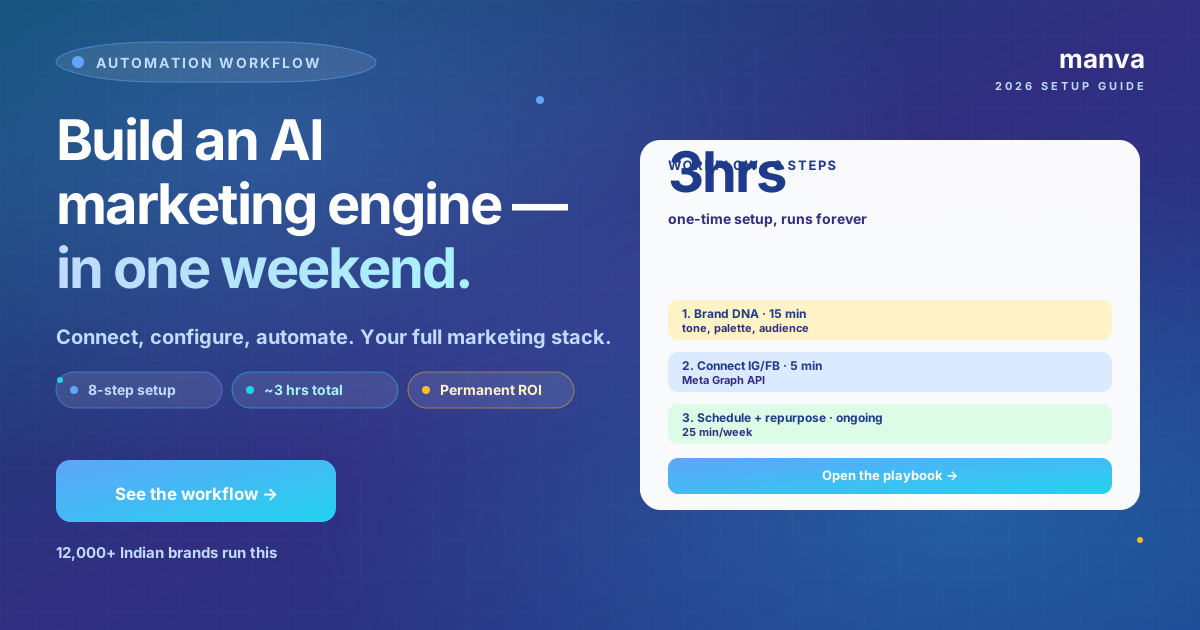
A marketing automation workflow sounds technical. It isn't. It's a system that runs your social media content on autopilot — you set it up once, and it handles the daily execution without your involvement.
This guide walks through setting up that workflow step by step, with specific recommendations for Indian businesses. No agency required. No technical background needed.
What a Marketing Automation Workflow Actually Is
Think of it as a production line. At one end, you put in raw material — product photos, brief descriptions, upcoming festival dates. At the other end, polished posts come out, scheduled and published across your platforms at the right times.
The workflow has four stages: content planning, content creation (captions and design), scheduling, and performance review. Automation handles stages two and three almost entirely. You handle one and four.
Stage 1 — Content Planning (30 Minutes Per Month)
Once a month, block 30 minutes to answer these questions:
Which products or services do I want to feature this month?
What festivals or occasions fall in this period?
Do I have any promotions, sales, or new launches planned?
What customer questions or objections should I address in educational posts?
The output is a simple content calendar — a list of post topics mapped to dates. It doesn't need to be detailed. "Tuesday 14th — new dupatta launch, ₹599" is enough.
Stage 2 — Content Creation (1–2 Hours Per Week)
With your content calendar in hand, open your automation platform and create the week's posts in one batch. For each post: upload the photo, enter the brief description and price, select a template, review the auto-generated caption, make small edits if needed, and queue it for scheduling.
With a tool like Manva.ai, each post takes 3–5 minutes. A week of 5 posts takes 20–25 minutes. A month of 20 posts takes under 2 hours total — done in one Sunday sitting if you prefer.
Batch creation tip: Create content in batches, not daily. Switching context from running your business to creating content and back again is expensive mentally. One focused session per week or per month is far more efficient than daily content creation.
Stage 3 — Scheduling and Publishing (Automatic)
This stage runs without you. The automation platform posts your content at the scheduled times across all connected platforms simultaneously. While you're at your shop, with a customer, or asleep — your posts are going live on Instagram, Facebook, and wherever else you're connected.
This is the highest-value part of the workflow for most business owners: the elimination of the daily interruption of "I need to post something today."
Stage 4 — Performance Review (20 Minutes Per Week)
Once a week, spend 20 minutes looking at what performed. Which posts got the most reach? Which generated comments or DMs? Were there particular times that got better engagement?
You don't need complex analytics. Three questions are enough: What was my best post this week and why? What was my worst and why? Is my overall engagement trending up or down over the last 4 weeks?
Stage
Time Investment
Frequency
Who Does It
Content Planning
30 minutes
Monthly
You
Content Creation
1–2 hours
Weekly
You + automation
Scheduling/Publishing
0 minutes
Daily
Automation only
Performance Review
20 minutes
Weekly
You
Set Up Your Automation Workflow Today
Manva.ai gives you the complete workflow — planning, creation, scheduling, analytics — built for Indian businesses. Start free.
The most common gap. Most Indian businesses create festival content the day before the occasion, when they're busiest. Build a 2-week buffer — create Diwali content in early October, not on November 1st when you're managing orders and decorating the shop.
Posting Without a CTA
Posts that end with no clear action instruction underperform consistently. "DM us to order," "click link in bio," "comment your size below" — every post needs one clear next step. Automation tools that follow proper caption structures include this automatically.
Ignoring WhatsApp
Most Indian small businesses have an informal WhatsApp broadcast group that they update irregularly. Formalising this into an automated WhatsApp Business broadcast — new arrivals, weekly offers, festival announcements — adds a direct sales channel with 90%+ open rates. Don't leave this unstructured.
Results by Timeline
Week 1: Workflow is set up. First batch of content is scheduled. The daily manual posting task is eliminated.
Month 1: Posting consistency improves dramatically. Reach grows from frequency. You notice you're thinking about social media less, not more.
Month 3: The compound effect is visible. Follower growth is consistent. Customer DMs from social media are a regular part of your sales pipeline. The workflow takes under 2 hours per week to maintain.
Frequently Asked Questions
How does social media automation work for Indian businesses?
Frequently Asked Questions
How does social media automation work for Indian businesses?
social media automation works by automating content creation, scheduling, and analysis. You provide your product or topic, AI generates optimised content in your language, schedules it at the best time, and posts it to all your connected platforms automatically.
Share this article:
Frequently Asked Questions
AI marketing uses artificial intelligence to automate the creation, scheduling, and optimisation of your marketing content. The key difference from regular digital marketing: AI handles the repetitive execution work automatically, so tasks that used to take hours — writing captions, designing posts, deciding when to publish — now take seconds. For a small business, this means getting consistent, professional-quality marketing without hiring a team or spending hours every day on content creation. You bring the strategy and products; AI handles the rest.
AI marketing tools start at ₹149/month with Manva.ai's Starter plan — that's under ₹10/day for AI captions in Hindi and English, scheduling across Instagram and Facebook, and 5,200+ templates. Compare this to a social media manager (₹15,000–₹45,000/month), a digital marketing agency (₹25,000–₹1,50,000/month), or even a freelancer (₹8,000–₹20,000/month). AI doesn't replace strategic thinking, but it eliminates most of the execution cost — the part of marketing that's been most expensive and time-consuming for small businesses.
Indian AI marketing platforms built on models trained specifically on Indian data — Manva.ai uses Sarvam-M, trained on Indian language content — generate natural Hinglish that sounds like how Indian social media users actually write, not like a translated English caption. Generic Western AI tools (even GPT-4) can write Hindi but it often feels stiff. The difference is noticeable to Indian audiences. If your audience responds to Hindi or regional language content, choose a platform built specifically for Indian languages, not a general-purpose international AI.
Engagement improvements (more likes, comments, DMs per post) typically appear within 2–4 weeks of consistent daily posting. Meaningful follower growth usually shows at 6–10 weeks. Sales you can directly attribute to social media discovery typically begin at 60–90 days. The first 30 days often feel discouraging — this is normal. The algorithm takes time to understand your account and serve it to the right audiences. Businesses that quit before day 45 are abandoning the investment right before the inflection point. Commit to 90 days before evaluating results.
Instagram: 5–7 posts per week is the ideal range for growth. Below 4/week and the algorithm deprioritises your account; above 7 and quality typically suffers without a dedicated team. Facebook: daily posting works well for local businesses. WhatsApp Business broadcasts: 2–3 per week maximum — more and customers opt out. Without AI, 5–7 Instagram posts per week is unsustainable for a solo business owner. With AI, it becomes achievable by batching your weekly content creation in one 45-minute Sunday session.
When used correctly — no. AI generates drafts that you personalise before publishing. A well-prompted AI output for your ethnic fashion brand in Jaipur will reference relevant festivals, use your brand's voice, and speak to your specific customer's aspirations. It won't look generic unless you provide generic input. What makes AI content feel fake is bad prompting (too little context about your brand and audience) and publishing without review. Give the AI rich context, review every output before posting, and the result will read as if a skilled copywriter who knows your business wrote it — which, in a meaningful sense, is exactly what happened.
For product businesses (fashion, food, jewellery, decor): new arrival carousels (5–8 slides showing different angles and styling options) consistently outperform single product images. Reels — short videos of product making, packaging, or styling — outperform static posts 5–8× for reach. Educational content (styling tips, care guides, sourcing stories) gets the most saves, which drives the most algorithmic reach. For service businesses (coaching, clinics, salons): results/transformation posts, team spotlights, and daily tips generate the highest engagement. AI generates all these content types efficiently — specify the content type in your prompt and the AI will adapt its output accordingly.
Ready to Start AI Marketing?
Join 8,200+ Indian sellers using Manva.ai to post professional content daily — in Hindi, English, and 10 more languages. Try free for 7 days — no credit card needed.