Most blogs on Indian small-business websites die in two stages. Stage one: a founder spends a Sunday writing 800 words about "why our product is great." Stage two: they look at Google Analytics three months later, see zero visits, and conclude blogging "doesn't work for our industry." The blog stays live but never updates. The website looks abandoned. The opportunity is wasted.
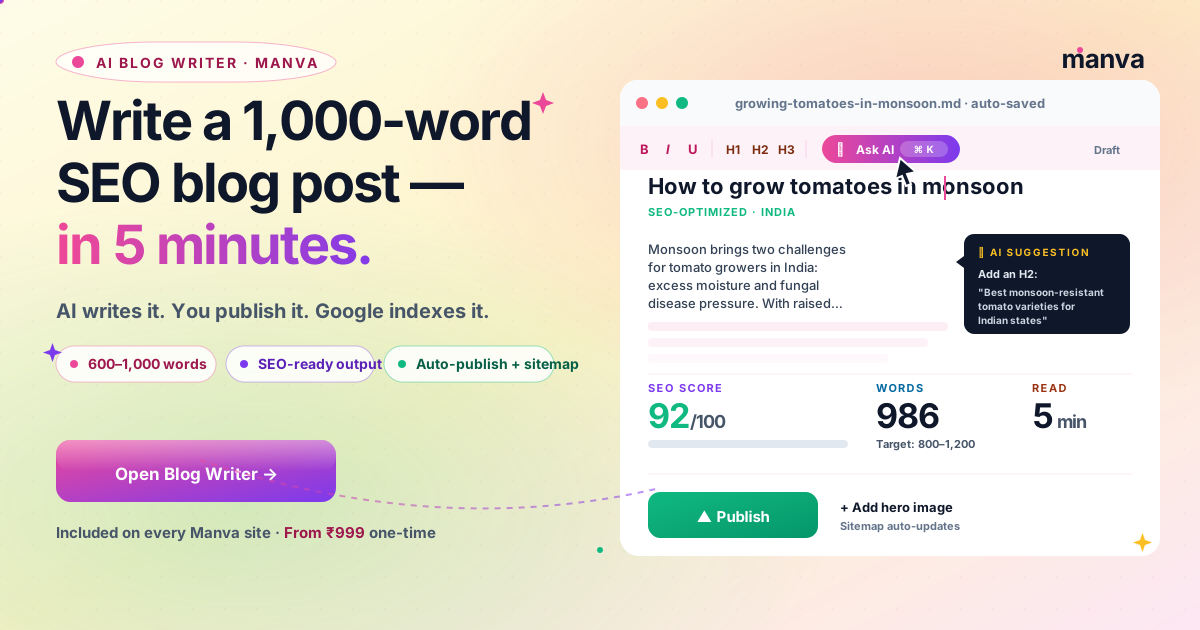
The boring truth is that blog content still works extremely well for Indian SMBs in 2026 — when you write to a question someone is actually typing into Google, structure it for both readers and crawlers, and ship consistently. The reason most founders don't get there is not effort or talent. It's the friction of writing. With Manva's built-in AI Blog Writer, that friction collapses to about five minutes per post.
This guide is the full workflow we use ourselves and that 4,000+ Manva sites use to publish posts that rank, drive enquiries and compound over time. It's longer than the typical "5 tips" listicle on purpose — blogging that actually works is a system, and a 200-word overview will not give you that system. Bookmark it; use it for the first ten posts you write.
Why blog content still beats paid ads in 2026 (especially for small Indian businesses)
Paid acquisition got expensive in 2024–2025 — Meta CPMs in India are up 30–60% in most categories, Google Ads CPCs for high-intent buyer keywords now routinely cost ₹40–₹150 per click, and the playbook of "boost a Reel for ₹500" has stopped working at scale. A competent brand can still buy traffic; what changed is that the unit economics now require a much higher conversion rate to break even. Most small businesses don't have that conversion rate.
Blog content does the opposite. A single well-written post that ranks for a buyer query — say, "best raised bed soil for Indian monsoon" — keeps producing free, qualified visitors for 24–36 months at zero marginal cost. The first three months are the painful part: barely any visits, no obvious signal that it's working. Months four onward, the same posts surface in Google's "People Also Ask," in answer-engine quoted snippets, and in long-tail searches you didn't even target. Compounding takes a quarter to start; it then accelerates for two years.
Three structural factors make this 2026 trend even stronger in India:
- The Indian search market is finally large enough. 750+ million Indians are online; the long-tail of buyer queries in regional languages and Hinglish is now indexed and ranked.
- Most competitors haven't caught up. Outside the top 10–15 D2C brands in any category, almost no Indian SMB publishes blog content seriously. Ranking for niche queries is dramatically easier than in the US/UK.
- AI removes the only real barrier — writing time. The bottleneck used to be sitting down to write 1,000 words. AI handles 90% of that in 45 seconds, and the editing loop is faster than starting from blank.
The rest of this guide assumes you accept that premise and want to actually do the thing. If you're still not convinced, set a date on your calendar in 90 days, ship 12 posts using the system below, and check your Google Search Console traffic on that date. The numbers will speak for themselves.
This is by far the most important step. Get topic-picking right and a 600-word post will rank; get it wrong and a 3,000-word essay will get zero visits. The single rule: write to a question a real buyer is actively typing into Google — not a topic you find interesting, not "industry trends," not generic thought leadership.
The fastest way to find these queries, with no paid tools needed:
- Type your category seed into Google. "Tomato seeds india," "wedding lehenga," "GST registration." Watch the autocomplete suggestions and the "People Also Ask" boxes that appear on the results page. Each autocomplete and PAA item is a real query Google has data for.
- Look at "Searches related to" at the bottom of results. These are queries Google's data says are commonly searched alongside the one you tried.
- Use Manva's blog topic research tool — it surfaces low-competition long-tail queries in your category with estimated monthly volume specifically for Indian search.
- Read your customer DMs and WhatsApp. Every "is this available in size XXL?" or "do you ship to Guwahati COD?" is a topic. The questions buyers ask before purchase are exactly the queries they typed before finding you.
From the list you generate, prioritise topics with three traits:
- Buyer intent — the question implies the person is close to buying, not just curious. "How to choose monsoon tomato seeds for North India" beats "history of tomato cultivation."
- Specificity — long, specific queries ("best cotton kurta for Hyderabad summer wedding") have less competition and higher conversion than short ones ("cotton kurta").
- You can answer well — write what you actually know. If you've never grown tomatoes in monsoon, don't lead with that post. Pick a topic where your answer beats a generic AI summary.
Spend 15 minutes building a list of 12 topics before you write the first post. You'll save yourself months of "I wrote a blog and nobody came."
From your Manva dashboard: Pages → Blog → New Post → AI Writer. The Blog Writer opens with seven inputs, and the quality of the output depends almost entirely on how carefully you fill them in. Don't accept the defaults. Two minutes of thoughtful configuration here is worth thirty minutes of editing later.
The seven inputs and how to fill each
- Topic / Title: paste the buyer query you picked from Step 1, exactly as someone would type it. The title field becomes both the H1 and a strong title-tag SEO signal — keep your primary keyword in the first 60 characters.
- Audience: describe in one line who the post is for. "Indian small business owners researching their first website" produces a different output than "marketing managers at mid-size SaaS companies." The model uses this for vocabulary, examples and reading level.
- Tone: friendly, professional, expert, conversational, witty. For Indian SMB content, "friendly + expert" is the sweet spot; pure "professional" reads stiff and corporate.
- Language: English, Hindi, Hinglish, Tamil, Telugu, Bengali, Gujarati, Marathi, Kannada, Malayalam, Punjabi, Odia. The AI generates natively in your chosen language — no translation step.
- Target word count: 600 for quick "how to" posts, 800–1,000 for buyer-intent posts, 1,200–2,000 for cornerstone guides like this one. Don't aim for 3,000 words on your first post; that's a guide, not a blog.
- Primary keyword: the single most important phrase you want the post to rank for. The AI will use it in the first paragraph, at least one H2, and the meta description. Choose it from your topic research, not from instinct.
- Secondary keywords: 3–5 supporting phrases. The AI weaves these in naturally where they fit.
Once configured, click Generate. The first draft appears in the editor in 25–45 seconds. Do not publish it as-is. Step 3 is where the real value gets added.
AI gets the structure of a blog post almost perfectly: the H1 reads like a headline, H2s break the topic into logical sections, the intro states the question and the conclusion summarises. What AI gets wrong is the middle. The middle is where AI produces filler — phrases like "in today's fast-paced world," "it's crucial to understand," "various factors." These are signals that the model didn't have a specific fact, so it generated a generic linking sentence to bridge ideas.
Your editing pass should do four things:
- Cut 15–25%. Read each paragraph and ask "would a smart reader miss this?" If the answer is no, delete it. Most AI drafts get tighter and better with aggressive cuts.
- Replace generic claims with specific numbers. "Many businesses see growth" → "12,000+ Indian businesses on Manva post 5+ times a week." Specific numbers are the fingerprint that this content is real, not generic.
- Add one personal story or proprietary observation. Something only you could write — a customer anecdote, a result from your own data, a specific failure. AI can't fabricate this; it's the moat for your blog vs. competitors who also use AI.
- Read it out loud, once. Awkward sentences become obvious when spoken. Fix or cut them.
This whole pass takes 4–8 minutes for a 1,000-word post once you have the rhythm. Don't over-edit; the goal is publishable, not perfect. A B+ post published this Tuesday outperforms an A+ post that ships in three weeks.
The Blog Writer is included on every Manva site
Build your website from ₹999 one-time, and the AI Blog Writer (plus visual editor, sitemap, RSS, hero image generation) ships with it. No monthly blog fee.
Build a websiteSEO has 200+ ranking signals, and 95% of them don't matter for a small Indian business website. The 5% that do, you can apply in 90 seconds per post, and Manva pre-fills most of them automatically. Here's the short list — the only things you actually need to check before publishing.
The on-page SEO checklist
- One H1, multiple H2/H3. The H1 is your title; the AI Blog Writer produces this correctly. Don't add a second H1 anywhere.
- Primary keyword in H1, first paragraph, and one H2. Naturally — don't force it. The AI does this by default if you filled in the keyword in Step 2.
- Meta title under 60 characters. What appears in Google's blue link. Manva auto-fills this; tighten it if it overflows.
- Meta description 140–160 characters with one concrete number or price. "5-minute guide to publishing your first AI-written blog on Manva — included with the ₹999 plan" beats "everything you need to know about AI blogging."
- Internal links to 2–3 other pages on your own site. A link to your product page, your pricing page, and one related blog post. This is the single highest-leverage SEO lever for new sites.
- One outbound link to an authoritative source if relevant. Don't force it; if there's a natural reference (a research paper, a stat from a known publication), include it.
- Slug should match the title without filler words.
/blog/best-monsoon-tomato-seeds-indianot/blog/post-117-2026-05-04. - Schema.org markup is auto-generated by Manva. Article + FAQ + BreadcrumbList — no work needed from you.
Two SEO myths to ignore: keyword density above 1% (Google stopped caring around 2014), and over-stuffing the meta keywords tag (it's been deprecated for over a decade). Don't waste time on either.
Every blog post needs one hero image at the top. It serves three purposes: it gets used as the OpenGraph preview when someone shares your post, it makes Google Discover and "People Also Ask" cards more likely to show your post, and it gives the reader a visual moment of "yes, I'm in the right place." Posts without a hero image have measurably lower social click-through and lower time on page.
You have three options for sourcing the image, and Manva supports all three:
- AI image generation — describe the image in one sentence ("hero illustration: a person typing a blog post on a laptop, warm sunset light, minimalist, Indian setting"), pick one of the four variations, and you're done. ~10 seconds.
- Stock photo from Pexels — Manva's image library searches Pexels by your topic. Free, royalty-cleared, attribution included automatically.
- Your own photo or screenshot — drag-drop from your computer. For product blogs, your own photos out-perform stock by a wide margin.
Whichever source you use, always set the alt tag. Alt text serves two audiences: screen readers (an accessibility requirement) and Google's image crawler (a ranking signal for image search and a context signal for the post). A good alt tag describes what's in the image and naturally includes your primary keyword.
Bad alt: "blog image" or worst of all, leaving it blank.
Click Publish. Three things happen automatically in the next 60 seconds:
- The post becomes live at your custom URL (
yourbrand.com/blog/your-slug). - Manva updates your
sitemap.xmland pings Google Search Console — Google usually crawls within 1–6 hours for a healthy site. - The post is added to your RSS feed at
/rss.xml, which feeds Google News, blog readers, and any subscribers.
Then comes the part most founders skip: cross-posting. A blog post that gets shared on social during its first 48 hours of life ranks better, faster — Google watches initial signals like clicks and time-on-page. Manva's Social Media Assistant turns the post into a 1-click cross-post:
- Instagram carousel — auto-generates 5 slides from the post sections, with a hook caption and your hashtags.
- Facebook post — title, summary, link.
- WhatsApp Business broadcast — to your opted-in customer list with a short summary and the link.
- LinkedIn post — for B2B audiences.
- Email to subscribers — if you've enabled the email integration.
Setup takes 30 seconds; from then on, every blog you publish goes out across all channels in one click. This single integration is the difference between a blog that compounds and one that posts into a void.
A 90-day blog calendar that compounds
Most "blog 100x a day" advice is unrealistic for an SMB owner who also runs operations, sales and customer service. Here's a sustainable 90-day cadence that actually compounds:
| Week | What to publish | Approx. effort |
|---|---|---|
| Week 1 | Cornerstone post — 1,500–2,000 words on your most important buyer query | 60 min (longer first time) |
| Week 2 | Supporting post — 800 words on a subtopic of the cornerstone, linking back | 30 min |
| Week 3 | Comparison post — "Best X for Y" with 5–7 options, your product included objectively | 30 min |
| Week 4 | How-to post — step-by-step that solves one specific buyer problem | 20 min |
| Weeks 5–12 | 2 posts per month, alternating supporting and how-to formats | 40 min/month |
By day 90 you'll have 8 posts live, internal links between them, and Google Search Console data showing which posts get impressions. The posts with the most impressions are your signal — write more like those. The posts with zero impressions are signal too — fix the title and meta, or retire them.
Common mistakes (and how to avoid each)
1. Writing about your company instead of the buyer's question
"Our journey," "why we started," "company values." These belong on your About page, not your blog. The blog is for queries your buyers type into Google. If the post title doesn't match a search query, retire it.
2. Publishing once and abandoning
Google rewards active sites. A blog with 4 posts from January 2024 and nothing since signals "abandoned" to crawlers. Publish 2 posts per month, every month, even if some are short.
3. No internal linking
Every new post should link to 2–3 older posts and to one product/pricing page. Older posts should be edited to link forward to the new post when relevant. This is how a blog turns into a network instead of a list of orphans.
4. Generic AI output published as-is
You can spot a totally unedited AI post within 10 seconds — the generic phrasing, the "in today's fast-paced world" intros, the lack of specific numbers. Google's helpful-content classifier can spot it too. Edit. Always edit.
5. Ignoring Google Search Console for 6 months
Connect Search Console to your Manva site on day one. Check it once a week — even 5 minutes is enough. The "Performance" tab shows you which queries are bringing visitors; this is the data that tells you which post to write next.
What to do after your first 4 posts
Once your first month is shipped:
- Add Google Search Console to your Manva site (Settings → SEO → Search Console). Verification is auto-handled via DNS.
- Layer in Instagram growth — every blog you publish becomes Instagram content via the Social Media Agent, doubling the reach of your effort.
- Pick your second cornerstone topic — the next big buyer query you can win. Write a 2,000-word piece. Link your existing posts to it.
- Enable the Brand DNA on your site so AI-generated content sounds consistently like you.
- Compare AI tools — read our ranked guide to the best AI tools for social media marketing in 2026 if you want to layer more channels on top of blogging.
Frequently asked questions
Ship your first AI blog post in the next 5 minutes
Build your Manva website from ₹999 one-time. The AI Blog Writer, visual editor, sitemap, RSS and cross-post integrations all ship with it. No monthly blog fee.