Most product descriptions on Indian ecommerce sites are killing sales.
They're vague. They list features in robotic sentences. They ignore the buyer's actual question. And worst of all — they're written in English when 70% of the buyers shop in Hindi or a regional language.
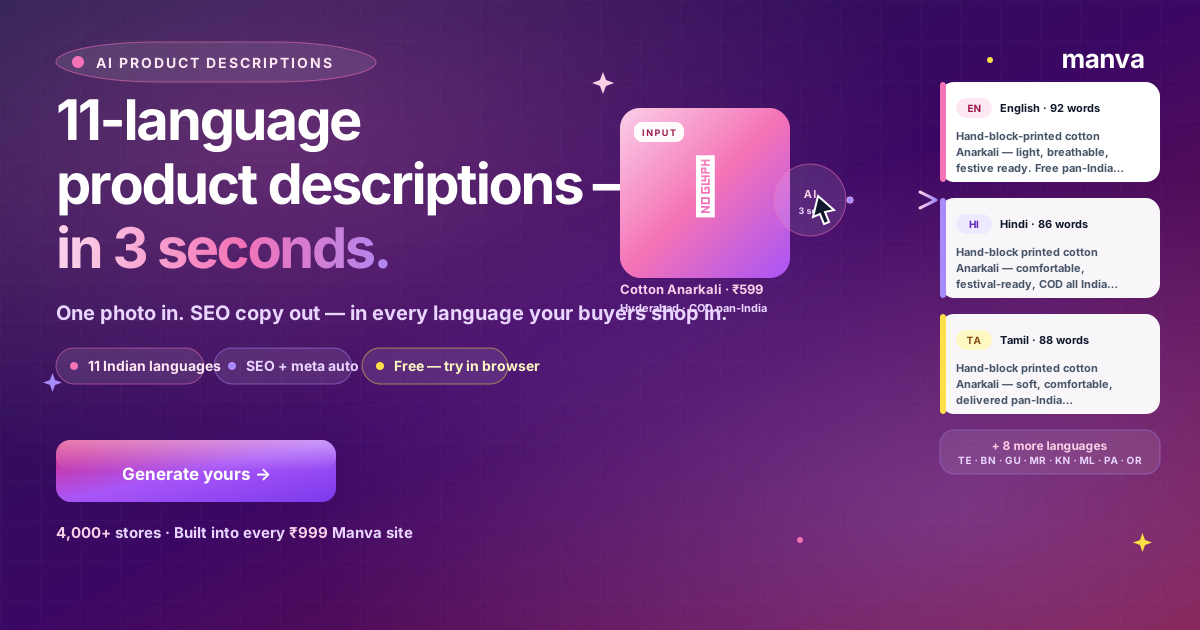
Here's the good news: AI fixes all of this in 3 seconds per product. In 11 Indian languages. For free.
This guide is the exact workflow used by 4,000+ Manva stores to turn product photos into descriptions that rank on Google and convert on the page. Templates, examples, mistakes — everything's here.
Let's get into it.
Why product descriptions matter more than you think
Quick test: pull up your last 10 product pages. Read the descriptions out loud.
If they sound like a spec sheet, you're losing money.
Here's what the data says:
- Product pages with detailed descriptions convert 78% better than those with one-line copy (Baymard Institute, 2024).
- 67% of Indian online shoppers abandon a cart because the product info wasn't clear enough (RedSeer, 2025).
- Product descriptions are the #1 SEO signal Google uses to rank category pages — more than backlinks for category-level queries.
- Descriptions in the buyer's native language convert 2-3x better than English ones in tier-2/3 India.
Bottom line? Your product description is doing three jobs at once:
- Selling the buyer who's already on the page.
- Ranking the page on Google so new buyers find you.
- Filtering wrong-fit buyers (preventing returns later).
Skip the description and you fail at all three.
The 5 elements every great product description has
Look at any high-converting Indian ecommerce store — Manyavar, Bewakoof, FabIndia, Nykaa. Their descriptions all have the same five pieces.
1. The hook (1 sentence)
Opens with the use-case or emotion, not the product name. "Perfect for a Hyderabad summer wedding" beats "This is a cotton kurta."
2. The promise (1-2 sentences)
What this product specifically does for the buyer. "Hand-block-printed in Jaipur, breathable through 38°C afternoons."
3. The proof (1 sentence)
Specific detail only an expert would know. Material grade, GSM, country of origin, days of craft. This is what AI-generated copy usually misses — and what you should add.
4. The spec list (4-6 bullets)
Buyers scan. Bullets respect that. Material, fit, dimensions, care, COD/return policy.
5. The CTA implicit close
One line that tells them what to do. "Free shipping on orders above ₹999. COD pan-India."
That's it. Five pieces. ~100-150 words total. Every product, every time.
Now let's see how AI does this in 3 seconds.
Step 1 · Start with the buyer query
This is where 90% of stores get it wrong.
They start with the product. You should start with the buyer query.
What's the exact phrase someone would type into Google to find this product? "Cotton kurta for summer wedding". "Silver jhumkas under 500". "Diya set for Diwali."
Use Google autocomplete. Use the People Also Ask boxes. Use your customer DMs. Each real query is a topic for a description that will rank.
Bad vs good — same product
Cotton Kurta — Pink
This is a beautiful pink cotton kurta made from high quality material. Available in all sizes. Comfortable to wear.
Hand-block-printed cotton kurta — perfect for Hyderabad summer weddings.
Light, breathable Jaipuri block-print cotton (180 GSM) that survives a 38°C afternoon and a 200-guest reception. Hand-finished cuffs, side slits for movement, washable in cold water. Free shipping above ₹999. COD pan-India.
Same product. Different page rank. Different conversion. Same 30 seconds of work — once you have AI.
Step 2 · Use the AI generator
Open Manva's AI product description generator. Five inputs. Three seconds.
The 5 inputs that matter
- Product name and category — "Hand-block cotton kurta" / "Women's ethnic"
- Buyer query — "cotton kurta for summer wedding Hyderabad"
- Tone — friendly, premium, witty, professional
- Length — short (60w), standard (120w), detailed (200w)
- Language — English, Hindi, Hinglish, Tamil, Telugu, Bengali, Gujarati, Marathi, Kannada, Malayalam, Punjabi, Odia
Hit Generate. The AI gives you 3 description variations to pick from.
Pick one. Move on. Don't overthink.
A B+ description published today beats an A+ description that ships in a week.
Try the generator free in your browser
11 Indian languages. Three-second output. No credit card. Built into every Manva ₹999 store.
Generate a descriptionStep 3 · Edit for your brand voice
AI gets you to 85%. The last 15% is what makes you different from every other store using the same AI.
Here's exactly what to edit:
Cut the filler
Delete words like "premium," "high-quality," "amazing." They mean nothing. Replace with specifics.
Add one fact only you know
The artisan's name. The number of days the print took. A real customer quote. This is your moat. AI can't fake it.
Match your brand voice
Friendly? "You'll love this." Premium? "Crafted by hand in Jaipur." Cheeky? "Yes, it has pockets." Pick one. Stay consistent.
Read it out loud — once
If a sentence sounds awkward when spoken, fix or delete it.
Total edit time: 30-60 seconds per product.
Step 4 · Translate to 11 Indian languages
This is the step that 99% of Indian stores skip — and it's the highest-ROI step in this entire guide.
Here's why.
70% of Indian online shoppers prefer to read in their regional language (Google India, 2024). When the description is in Hindi, conversion goes up 2-3x. When it's in Tamil, the same. Bengali, Gujarati, Marathi — same pattern.
Your competitors are still publishing English-only. This is your unfair advantage.
How to do it (the right way)
Don't use Google Translate. Translated copy reads stiff and corporate. Buyers feel it.
Use Manva's AI to generate natively in the target language. The 5 inputs in Step 2 — just change the Language dropdown. Three seconds. Native copy.
The result: same product, 11 separate language pages, each ranking on Google for its own queries.
Which languages to start with
- English (always — for tier-1 and pan-India search)
- Hindi (for tier-2/3 reach)
- One regional language based on your customer base — Tamil, Telugu, Bengali, Gujarati or Marathi
Add more languages as you scale. Three languages cover 80% of Indian buyer intent for most categories.
Step 5 · Add SEO meta and alt text
The description is done. Five more SEO things, 60 seconds total.
Meta title (under 60 chars)
What appears in the Google blue link. "Hand-block Cotton Kurta — Summer Wedding | Aarohi Boutique"
Meta description (140-160 chars)
What appears under the blue link. Include a number or price. "Hand-block Jaipuri cotton kurta for summer weddings. Free shipping above ₹999. COD pan-India. Sizes XS-XXL."
Image alt text
Describe what's in the image, naturally including your primary keyword. "Pink hand-block cotton kurta for summer wedding — Aarohi Boutique". Skip this and you lose Google Image Search traffic.
Slug
Use words, not numbers. /products/hand-block-cotton-kurta-pink beats /products/12847.
Schema markup
Manva auto-generates Product + Offer + AggregateRating schema. Zero work from you. Verify at Google Rich Results Test.
That's the entire SEO setup. Done.
7 product description templates that convert
Copy these. Paste your product. Done.
Template 1 — The "Perfect For" hook (best for fashion / lifestyle)
"Perfect for [specific use case]. [Material/origin detail]. [One emotional benefit]. Free shipping above ₹999."
Template 2 — The "Made For" promise (best for handmade)
"Made for [audience]. Crafted by [artisan/origin]. Takes [time] per piece. [Specific differentiator]. COD pan-India."
Template 3 — The problem-solution (best for tools / gadgets)
"Tired of [problem]? [Product] solves it in [way]. [Proof point]. [CTA]."
Template 4 — The story (best for premium / heritage)
"In [origin city/village], [tradition] takes [days/process]. This [product] is the result. [Specific detail]. Limited stock."
Template 5 — The comparison (best for tech / electronics)
"Unlike [competitor type], this [product] does [unique thing] for [benefit]. [Spec]. [Warranty]."
Template 6 — The festival (best for seasonal)
"This [festival] season, [product] for [audience]. [Sensory detail]. Order by [date] for delivery before [festival]."
Template 7 — The straight value (best for budget categories)
"[Product] at [price] — [single specific benefit]. [Practical detail]. [COD note]."
Real before/after from 4,000+ Manva stores
Three examples. Real products. Real conversion lifts measured over 30 days.
Example 1 — Cotton kurta (fashion)
Pink cotton kurta. Made of high quality cotton. Comfortable. Available in all sizes. Wash with care.
Hand-block-printed cotton kurta — perfect for Hyderabad summer weddings.
Light, breathable Jaipuri block-print cotton (180 GSM) that survives a 38°C afternoon and a 200-guest reception. Hand-finished cuffs, side slits for movement.
Example 2 — Silver jhumkas (jewellery)
Beautiful silver jhumka earrings. Suitable for all occasions.
Pure 92.5 silver jhumkas — handmade in Rajasthan, light enough for all-day wear.
Traditional bell shape with antique-finish detailing. 4.2g per pair, hypoallergenic, comes in a velvet gift box. Perfect for sangeet, mehendi, or daily wear.
Example 3 — Diya set (home/festive)
Set of 12 traditional diyas for Diwali. Made of clay.
Hand-painted clay diyas — set of 12 for Diwali, decorated by women artisans in Jaipur.
Each piece individually hand-painted with traditional motifs. Burns 4+ hours with cotton wick (included). Eco-friendly clay, plastic-free packaging.
Notice the pattern? Specific. Sensory. Honest. No filler.
Common mistakes
1. Copy-pasting Meesho or Amazon descriptions
Google penalises duplicate content. Generate fresh with AI — takes 3 seconds.
2. Stuffing keywords
"Cotton kurta cotton suit cotton dress cotton clothing." Reads desperate. Modern Google penalises it. One primary keyword + 2-3 secondary, naturally placed.
3. Skipping the buyer query
If your H1 doesn't match a real Google query, you're writing invisible content. Always start with the query.
4. English-only on tier-2/3 products
If your buyers shop in Hindi, write in Hindi. AI does it in 3 seconds. Conversion goes up 2-3x.
5. Forgetting alt text on images
Free Google traffic, ignored. Manva nudges you when alt is missing — don't dismiss the prompt.
Frequently asked questions
Generate your first AI description in 3 seconds
The AI generator is built into every Manva ₹999 store. 11 Indian languages, SEO meta auto-filled, image alt suggestions — all included.